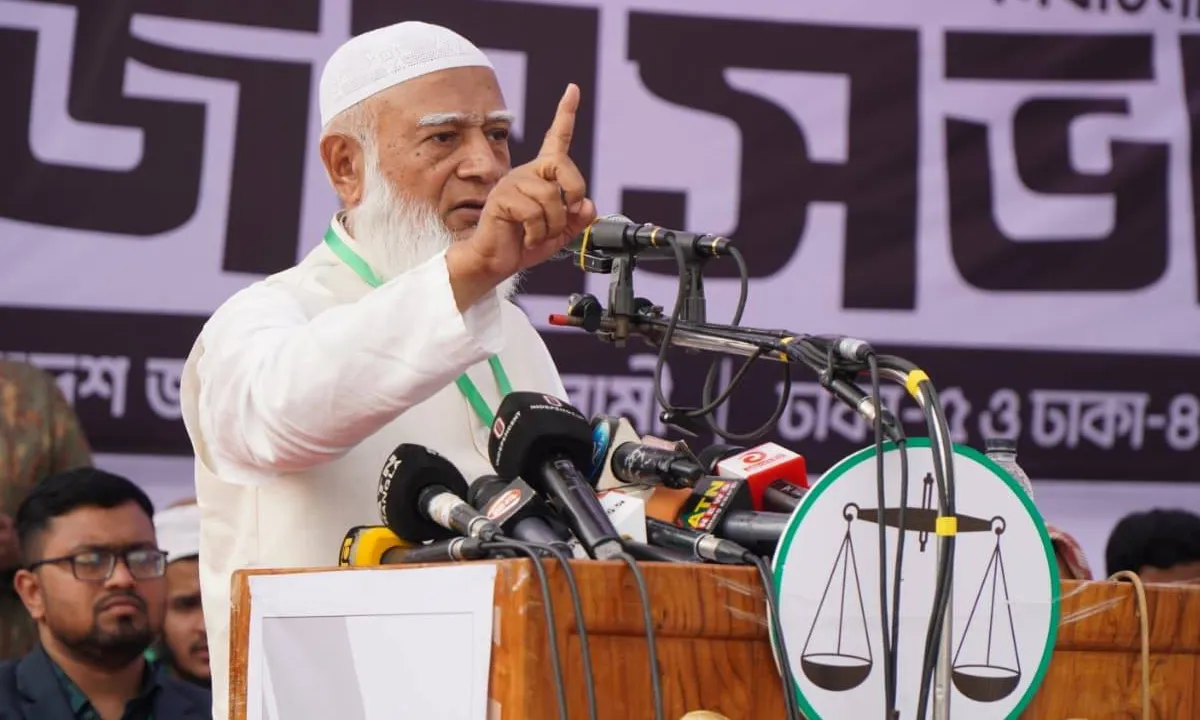

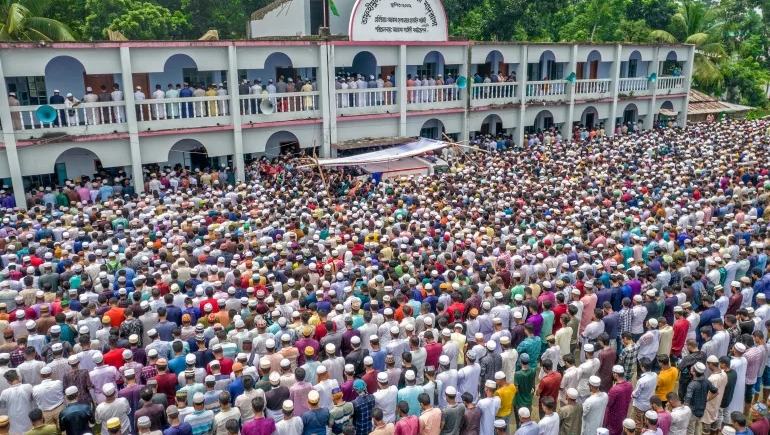
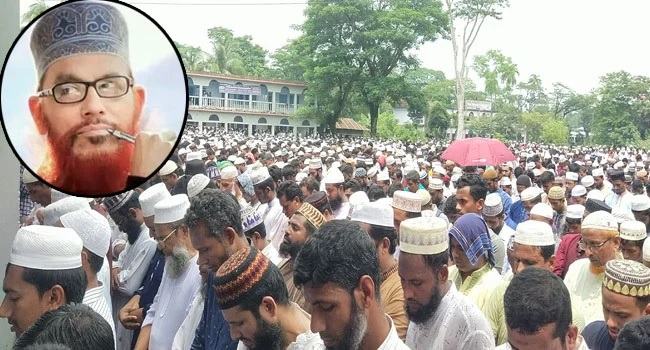
Delwar Hossain Sayedee, vice president of the opposition Jamaat-e-Islami party and a former member of Bangladesh’s parliament, has been buried beside the grave of his elder son on Sayedee’s foundation premise in the Pirojpur municipality area.
The funeral prayer was completed at 1:08 PM on Tuesday (August 15). Jamaat-e-Islami acting Ameer Professor Mujibur Rahman led the funeral prayers (Namaj-E-Janaza).
An estimated 100000 people have attended the funeral of an influential religious leader in Bangladesh whose death in prison triggered mass protests.
There was heavy police security at the funeral on Tuesday at Sayedee’s hometown in the coastal Pirojpur district.
Elsewhere in the country, one person was killed during a confrontation between police and a group trying to hold a memorial ceremony for Sayedee.
Earlier on Tuesday at 10:08 AM, the car carrying Sayedee’s body reached Pirojpur under police guard. Immediately after his body reached Pirojpur, the police ordered to bury after a quick funeral.
Former lawmaker Delwar Hossain Sayeedi passed away around 8:40 pm on Monday (August 14) night in custody while undergoing treatment at Bangabandhu Sheikh Mujib Medical University (BSMMU) in the capital.
Sayedee, 83, a prominent Islamic scholar and speaker in Bangladesh, was taken to Bangabandhu Sheikh Mujib Medical University (BSMMU) in Dhaka on Sunday afternoon after suffering a heart attack.
He had been in prison for 13 years and was facing several health complications and passed away at the hospital while undergoing treatment, Brig. Gen. Md Rezaur Rahman, the director of BSMMU, confirmed to the media.
Thousands of Jamaat supporters began gathering at the hospital and chanting slogans against the government for keeping him in prison in “false” cases and due to “motivated” court verdicts.
Sayedee had been serving a life sentence for alleged crimes against humanity during the Bangladesh Liberation War.
His party, however, considered the trial controversial and regarded it as part of a political attempt to eliminate party leaders.
In a condolence message, the party said “A grave injustice has been done to him by imprisoning him for life in a false and fabricated case.”
In 2013, a local court called the International Crimes Tribunal sentenced Sayedee to death for crimes against humanity. At least 78 people died in clashes with police and other law enforcement agencies across the country in an immediate reaction to the court verdict.
The country’s Supreme Court in 2014 reduced the punishment to life imprisonment, however.
The crimes tribunal, set up in 2009, has been criticized by global rights groups for not following fair trial standards. Since then, it has delivered verdicts against over 130 people in over 50 cases.
Bangladesh gained independence from Pakistan in 1971 after a bloody war that lasted for months. The Jamaat-e-Islami party has been criticized for its alleged collaboration with the Pakistani army during the war.
The main Bangladeshi opposition Bangladesh Nationalist Party’s acting Chairman Tarique Rahman and Secretary General Mirza Fakhrul Islam Alamgir also expressed condolences over his death.
In separate messages of condolence sent to the media on early Tuesday, the party also prayed for the salvation of the departed soul of Sayeedi and conveyed profound sympathy to his bereaved family members, relatives, fans, and well-wishers.
In his condolence message, Fakhrul said that he was deeply saddened at the death of Sayedee as a prisoner.
Describing the Jamaat leader as an internationally renowned Islamic scholar, he said that Sayedee inspired the people of Bangladesh and other countries of the world toward the enlightened path of Islam.
Fakhrul said that the Jamaat leader was compassionate towards pious people and he devoted himself to the practice and propagation of pure Islamic knowledge among people.
He was a patient and eloquent speaker in the Parliament, the BNP leader said.
Fakhrul said that Sayedee had been in jail for 13 years with serious illness and he was not provided with proper treatment.
‘His death will remain as an unprecedented example of the cruelty of the autocratic ruler.’