

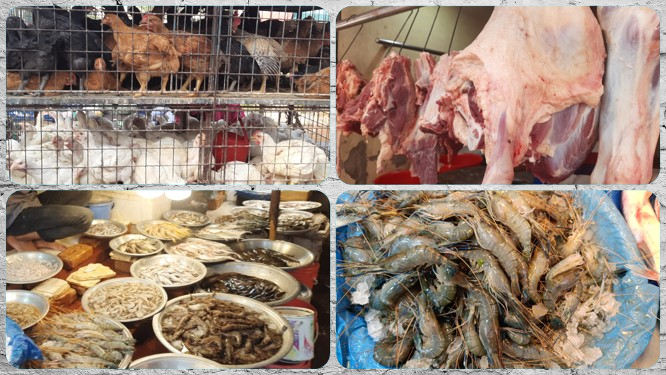
A market survey conducted on Friday, June 27, in areas such as Rampura, Banasree, and surrounding regions revealed these trends. Despite the Eid festivities being over, beef prices remain high, with no significant drop in the number of buyers, as many people still have sacrificial meat at home.
In contrast, broiler chicken prices have decreased due to a higher supply. Currently, broilers are priced between 140 to 150 taka per kg, compared to 160 to 170 taka before Eid. Golden chickens are being sold at 225 to 235 taka per kg, while red layers and white layers are priced at 240 and 230 taka per kg, respectively. Domestic chickens remain costly at 500 to 550 taka per kg, and ducks are priced at 600 to 700 taka per piece, depending on the breed.
On the other hand, beef is being sold at 750 to 780 taka per kg, khasi at 1100 taka, and goat meat at 1000 taka per kg. However, vendors report that there are fewer customers at these prices, with many opting not to resell sacrificial meat.
Egg prices have also steadily declined since Eid, with wholesale prices ranging between 118 to 120 taka per dozen. At retail shops, eggs are sold for 125-130 taka per dozen, down from 135-140 taka a few weeks ago. However, some neighborhood shops continue to sell eggs for 130 to 135 taka.
The fish market, which saw a shortage during Eid, has recovered, and a wide variety of fish is now available in ample supply. Fish such as rui, katal, pabda, shrimp, tengra, and shing are now found in sufficient quantities, with little fluctuation in prices.
Large-sized Rui and Katal fish are priced between 300 to 340 taka per kg, while pabda is sold for 350 to 400 taka. Shrimp is priced at 650 to 700 taka, tengra at 600-700 taka, and shing at 400-450 taka. Common tilapia and pangas are available at 180 to 200 taka per kg. However, local varieties like shing and kai are still scarce, priced at 1200 and 1000 taka per kg, respectively.
In Rampura market, housewife Nahida Sultana remarked, “After Eid, people no longer feel like eating beef, and the prices are too high. I noticed that broiler prices have dropped a bit, so I bought two kilograms, which is easier to cook and more affordable.” She also mentioned that fish prices were lower, and she purchased pabda and tilapia, as her children enjoy fish and it cooks quickly.
Bank official Mahfuz Alam shared, "We now need eggs almost every day at home, and we are saving a little money as eggs are 15-20 taka cheaper than before. However, some retailers are still selling them for 130-135 taka, which is not right."
Broiler and layer chicken seller Md. Saleh Uddin added, “Chicken sales have been increasing daily since Eid. People are tired of sacrificial meat and are opting for lighter meals. Broiler prices have dropped by 5-10 taka per kg, but the sales margin is low due to the lower prices.”
Md. Kawsar Mia, a fish seller in Moghbazar, explained, "During Eid, no one bought fish, and the shops were empty. But now, people are coming back, and the demand for fish has increased. Rui, Katal, and Pabda are the most popular. Prices have remained stable as fish is readily available, and those who didn't offer sacrifice or had less are now turning to fish and poultry.”
The post-Eid market shift indicates a change in consumer preferences, with lower- and middle-class buyers now gravitating more towards affordable fish, chicken, and eggs rather than beef. This trend has been amplified by the ongoing recovery of the fish market and decreasing poultry prices.


