
Time Digital Report: The government has decided to increase electricity prices by Tk 0.70 a unit which according to experts will predictably make prices of essentials soar yet again ahead of Ramadan.
Besides, the government has already increased the gas prices for power plants and decided to introduce a pricing formula for imported petroleum products, which was a condition for the IMF's $ 4.7 billion loan.
The new electricity prices will be effective from March 1. The prime minister has approved the new electricity price, according to power division officials.
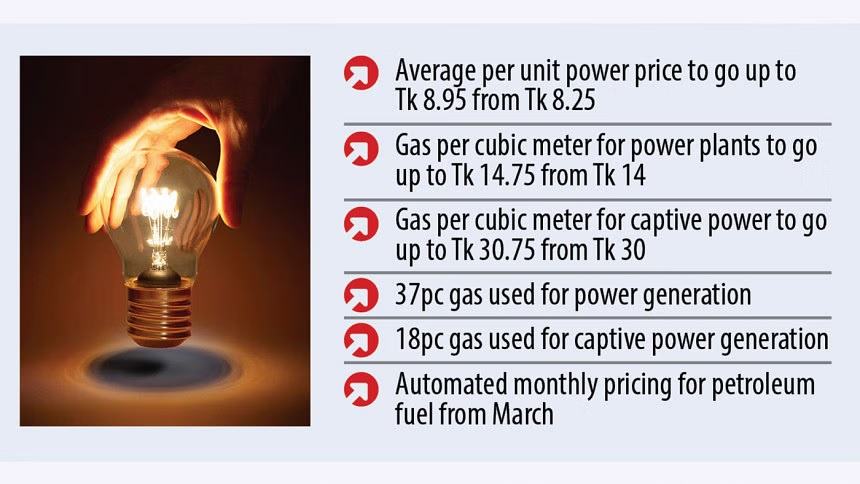
The new average power tariff per unit will be Tk 8.95 from the current Tk 8.25 while the bulk unit tariff will be Tk 7.04 from Tk 6.70, according to the power division.
The government increased the power tariff in three phases between January and March last year.
State Minister for Power and Energy Nasrul Hamid yesterday told reporters that around one crore subscribers who use very little electricity (fewer than 200 units) would pay only Tk 0.34 more for power while the rest would pay Tk 0.70 more.
The government is not increasing power prices, he said, it is merely adjusting it in a bid to lighten the subsidy burden amid the rise in primary fuel prices in the international market and the devaluation of taka against the dollar.
"Price increase is when we increase the prices above the break-even rate. We are adjusting it with fuel prices, something every other country does routinely… We have no other choice but to adjust the power price with the fuel cost," he said.
The average per unit production cost of electricity is Tk 12, he said, adding that the government subsidy has increased over the past year due to the huge changes in exchange rates.
"Subsidies this year will be around Tk 43,000 crore for electricity and around Tk 6,000 crore for gas."
The government is making such adjustments to withdraw the subsidy gradually from the power sector.
"We want the adjustment to start from the first week of March. And adjustment will be made slowly but gradually in the next two to three years," Hamid said.
Economists and consumer rights defenders said that the arbitrary hike in power prices came at a time when people were struggling to cope with high inflation, elevated transportation costs, and the price increase of almost all commodities.
Golam Rahman, chairman of the Consumers Association of Bangladesh (CAB), said the move will harm the market as people are already struggling with high commodity prices.
"The government initiative of bringing the entire country into the electricity network is a praiseworthy effort. But on the other hand, consumers are bearing the brunt of many wrong decisions like capacity charges and creating overcapacity," said Rahman.
He said that the government should correct its mistakes so that the people can get relief from additional charges.
Selim Raihan, executive director of the South Asian Network on Economic Modeling (SANEM), said that the government had no other alternative but to increase the power prices as its capacity to provide a big amount of subsidy has been shrinking due to low revenue.
"But the biggest concern is that the rise in power tariff will put free pressure on inflation. Businessmen often use Ramadan as an excuse to increase the prices of commodities. They will take the rising power price as another excuse to increase the commodity price further," said Raihan.
M Shamsul Alam, vice-president of CAB, said the government's decision to increase power prices bypassing the Bangladesh Energy Regulatory Commission (BERC), is a big injustice to consumers.
BERC, as an independent regulatory authority, normally determines tariffs, issues licences, and oversees dispute settlement in the power and energy sector.
The BERC public hearing was a process in which people could question the price hike proposals and access information like business profits, expenditures, and government subsidies.
However, the government amended the BERC Act-2003 in December 2022 which allows it to fix energy prices under "special circumstances".
GAS PRICES INCREASED
The government also has increased the price of gas used in power production by Tk 0.75 per cubic metre.
The price of captive electricity gas used in factories has also been hiked by the same rate, according to a gazette notification issued by the Energy and Mineral Resources Division yesterday.
At present, the price of each unit of gas used for power production is Tk 14 and captive power is Tk 30.
Prices of gas used in households and transportation have not been increased.
"The adjustment in gas price will not take place at the consumer's level. But adjustments will be made for gas used in producing electricity, said Nasrul Hamid.
According to the Energy Ministry, 37 percent of gas is used for power generation while captive power consumes 18 percent of gas.
Nasrul Hamid has also announced the introduction of an automated pricing formula for petroleum in the first week of March.
"We are going towards dynamic pricing with the consent from the finance ministry. Prices will be adjusted with crude oil prices linked to the world market."
Energy division officials said petroleum prices would be adjusted every month in line with the fuel prices of the global market.
The introduction of the pricing formula in March this year was one of the IMF conditions.