
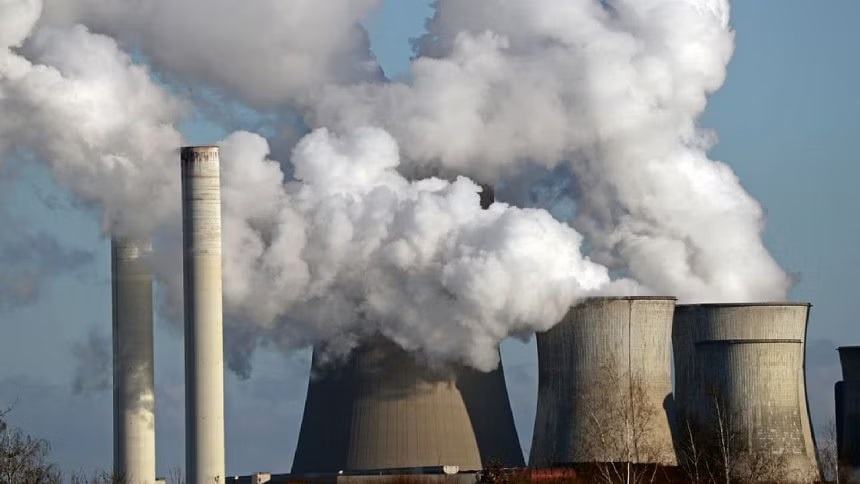
Climate change is having a measurable impact on air quality and therefore human health, meaning the two must be tackled together and not in isolation, a report released by the World Meteorological Organization (WMO) yesterday showed.
"Heatwaves worsen air quality, with knock-on effects on human health, ecosystems, agriculture and indeed our daily lives," said WMO Secretary-General Petteri Taalas in a statement.
"Climate change and air quality cannot be treated separately. They go hand-in-hand and must be tackled together to break this vicious cycle," he added.
According to the report, the effects of pollution resulting from high temperatures are often overlooked but just as pernicious.
Examples cited in the report include the north-western United States, where heatwaves triggered wildfires, as well as heatwaves accompanied by desert dust intrusions across Europe. Both led to dangerous air quality in 2022.
Brazilian case studies cited in the report showed how parks and tree-covered areas within cities can improve air quality, absorb carbon dioxide and lower temperatures, thus benefiting inhabitants.
While yesterday's report was based on 2022 data, Taalas cautioned that in terms of temperatures, "what we are witnessing in 2023 is even more extreme".
The European Union's Copernicus Climate Change Service said yesterday the Earth had just had its hottest three months on record, with last July the hottest month ever recorded, followed by August and that 2023 was on track to become the hottest year on record.
That is bad news for air quality levels.
Researchers meanwhile widely agree that climate change is causing more intense and more frequent heatwaves, and that this in turn is leading to a growing risk of more severe wildfires, WMO said.
"Heatwaves and wildfires are closely linked," said Lorenzo Labrador, a WMO researcher at the Global Atmosphere Watch network which compiled yesterday's Bulletin.
"Smoke from wildfires contains a witch's brew of chemicals that affects not only air quality and health, but also damages plants, ecosystems and crops -– and leads to more carbon emissions and so more greenhouse gases in the atmosphere," he said in the statement.
He stressed though that "it is yet too early to say" if 2023 would prove worse in terms of atmospheric pollution than last year, reports AFP.
"Even though this has been a record-breaking wildfire season, in particular in Europe and western Canada, ... the relationships and interactions and chemical processes that link climate change to atmospheric pollution are not linear," he told reporters in Geneva.
The 2022 data detailed in the report showed how heatwaves last year triggered wildfires in the Northwestern United States, leading to unhealthy air.
Soaring temperatures in Europe, accompanied by unusually high amounts of desert dust reaching the continent, meanwhile led to increased concentrations of both particulate matter and ground-level ozone, it said.
Stratospheric ozone helps to shield humans and vegetation from harmful ultraviolet rays from the sun.
But at ground level, where it is generated by a reaction between traffic fumes and sunlight, the gas attacks lung tissue, causing chest pain, coughing and shortness of breath.
It also reduces crop yield, with ozone-induced losses averaging 4.4-12.4 percent globally for staple food crops, and wheat and soybean losses as high as 15-30 percent in parts of India and China.