
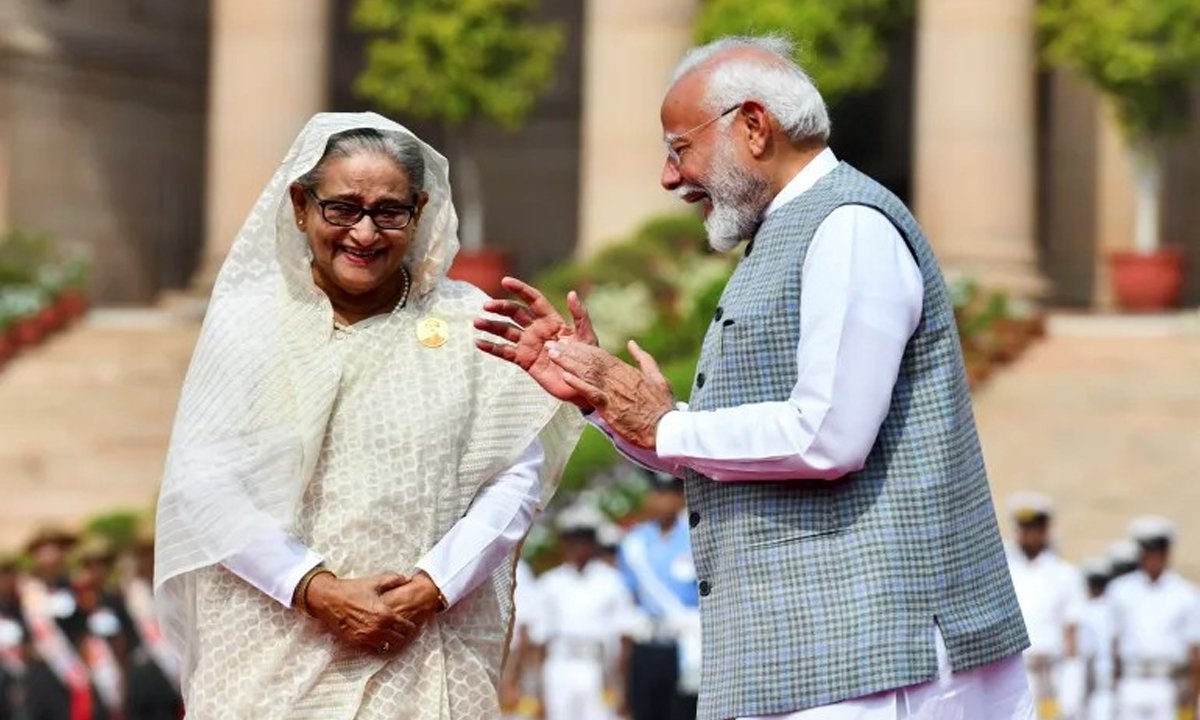
It further said, 'As a close neighbor, India is committed to protecting the interests of the people of Bangladesh, including peace, democracy, inclusion and stability in Bangladesh. We will engage constructively with all stakeholders to achieve this goal.'
Although New Delhi did not clarify anything about the extradition of Sheikh Hasina in the statement, the discussion on the extradition of Sheikh Hasina has started again after the International Crimes Tribunal announced the death sentence on Monday. Many are questioning whether India will return the former Prime Minister or not.
"The court's verdict against Hasina was expected. However, India will not extradite the fugitive former prime minister of Bangladesh," said Sriradha Dutta, a professor of South Asia studies at Jindal Global University in India.
The court verdict against Hasina was expected, but India will not extradite the fugitive former prime minister of Bangladesh.
- Sriradha Dutta
"India will not extradite him under any circumstances," he said. "In the last year and a half, we have seen that relations between India and Bangladesh have not been very good and have often felt fragile."
Commenting that 'Hasina's death sentence was expected', Sriradha Dutta said, 'No one has any doubt about the crime committed against unarmed students. There is also evidence that the Prime Minister directly ordered the shooting.'
There is no doubt about the crimes committed against unarmed students. There is also evidence that the Prime Minister gave the direct order to shoot.
- Sriradha Dutta
The South Asia expert at Jindal Global University added, "The Awami League will try to create a counter-narrative. But overall, Bangladeshis believe that Hasina has committed crimes against humanity."
The Awami League will try to create a counter-narrative. But overall, Bangladeshis believe that Hasina has committed crimes against humanity.
- Sriradha Dutta
Dutta
What is in the India-Bangladesh extradition agreement?
India and Bangladesh signed a bilateral extradition treaty in 2013. The treaty was later amended in 2016 to make the exchange of fugitive prisoners and defendants between the two countries easier and faster.
The deal was made in the context of several Indian fugitives, particularly those belonging to insurgent groups from northeastern India, hiding in Bangladesh and operating outside (India). At the same time, Bangladesh was also facing problems from organisations like Jamaat-ul-Mujahideen Bangladesh (JMB), whose members were found hiding in Indian states like West Bengal and Assam.
The prisoner swap agreement allowed New Delhi to successfully repatriate United Liberation Front of Assam (ULFA) top leader Anup Chetia from Bangladesh to India in 2015. Since then, Bangladesh authorities have handed over another fugitive to India through the agreement. India has also handed over several Bangladeshi fugitives to Bangladeshi authorities through the agreement in the past.
Under the agreement, India and Bangladesh are supposed to extradite to each other persons who have been charged with or convicted of, or who are seeking to be extradited by a court in the requesting country for, an extraditable offence.
Although Bangladesh has the right to seek Hasina’s return under the extradition treaty signed in 2013, the geopolitical and diplomatic implications of the deal remain complex. If India agrees to extradite Hasina, the process will involve a number of steps, both in terms of the letter of the India-Bangladesh extradition treaty and the harsh realities of international diplomacy.
Dr. Sangeeta Tak, an academic and legal expert who works as an assistant professor at the Rajiv Gandhi National University of Law in Punjab, said in February that while the strategic or terminological issues are largely governed by extradition treaties, political, diplomatic and human rights considerations make the treaty an incredibly complex and sensitive issue.
Tak said Bangladesh has submitted a formal extradition request to India for Hasina, and the process has begun. The request must detail the charges against Hasina and contain a strong collection of supporting documents, including court orders, arrest warrants and other evidence.
At that time, he emphasized that the extradition request must include (the assurance) that there will be a fair trial in Bangladesh and that the trial will not be biased.