
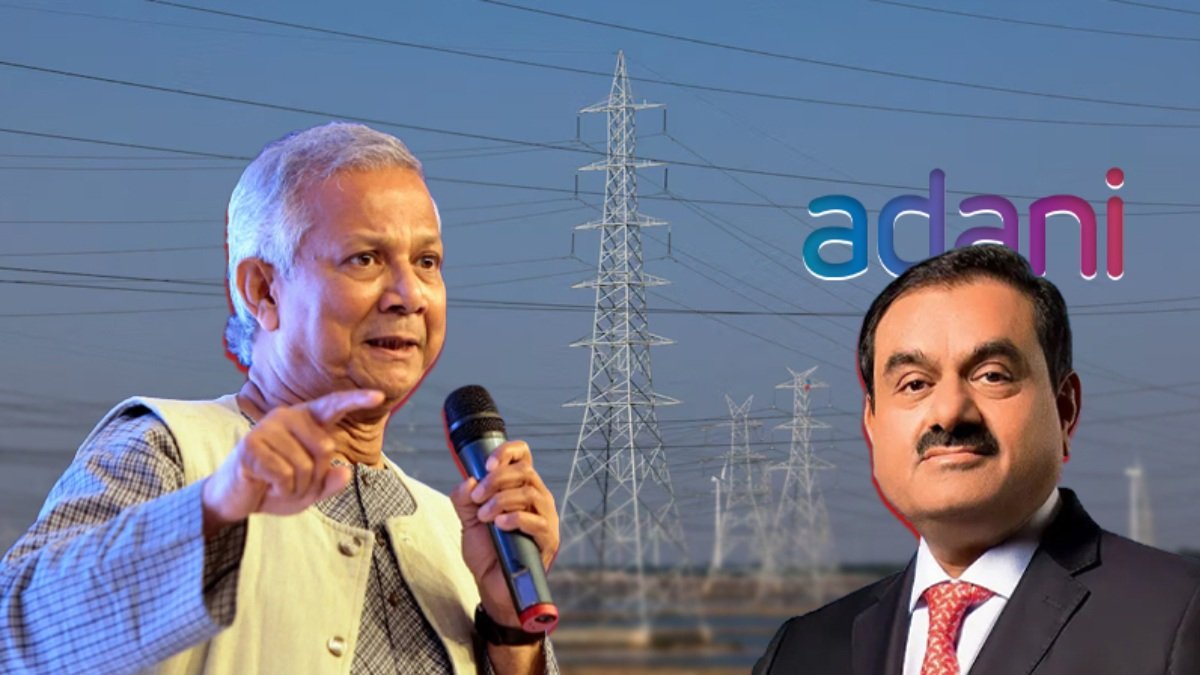
This announcement follows the submission of an interim confidential report by the National Review Committee, which was tasked with investigating allegations of large-scale corruption and administrative failures in the country’s energy sector.
According to a report published by the Times of India on Tuesday (November 4), the deal with the Adani Group was originally signed in 2017. The review committee was formed to scrutinize various power sector contracts signed during the tenure of the ousted Sheikh Hasina government.
The committee’s report found that a network of private companies, senior government officials, and bureaucrats dominated the power sector contracts under the former administration. The report alleged that the group was led by the then Prime Minister Sheikh Hasina, who also served as the Minister of Power, Energy and Mineral Resources.
It further stated that some officials from the Prime Minister’s Office (PMO) frequently interfered in power sector deals. The report specifically named two former power secretaries- Abul Kalam Azad and Ahmed Kaikaus- both of whom were later promoted to principal secretary positions in the PMO.
“We have found evidence of widespread corruption, collusion, fraud, irregularities, and illegality in the process of implementing several power purchase agreements,” said Moinul Islam Chowdhury, head of the review committee and a former judge, at a briefing on Sunday.
Following the meeting, Muhammad Fawzul Kabir Khan, Advisor on Power, Energy, and Mineral Resources, told reporters that while the government has not yet made a final decision, the contract could be canceled if the allegations are proven.
“In court, verbal assurances will not stand- there must be a clear legal basis,” he said, emphasizing that the Anti-Corruption Commission (ACC) and the Electricity Division are currently collecting evidence as part of an ongoing High Court writ petition against the Adani power deal.
The 25-year agreement between Adani Power and the Bangladesh Power Development Board (BPDB) requires Bangladesh to purchase 100 percent of the electricity produced by Adani’s 1,600-megawatt coal-fired power plant in Jharkhand, India. The plant was built solely to supply electricity to Bangladesh a clause that has drawn scrutiny since the fall of the Hasina administration.
However, committee member Mushtaq Hossain Khan cautioned that the deal is a sovereign state agreement, meaning it cannot be canceled unilaterally without potential repercussions. “If the contract is terminated without legal grounds, Bangladesh could face heavy fines in international arbitration,” he warned.
The review committee, formed in September 2024, has taken about 14 months to complete its preliminary investigation and aims to submit its final report by January.
Chairman Moinul Islam Chowdhury said the team reviewed extensive documents, payment records, and production data related to contracts signed under the Quick Enhancement of Electricity and Energy Supply (Special Provisions) Act, 2010 — a now-repealed law that allowed the government to bypass competitive bidding. “The volume of documents and complex procedures significantly prolonged our work,” he added.