

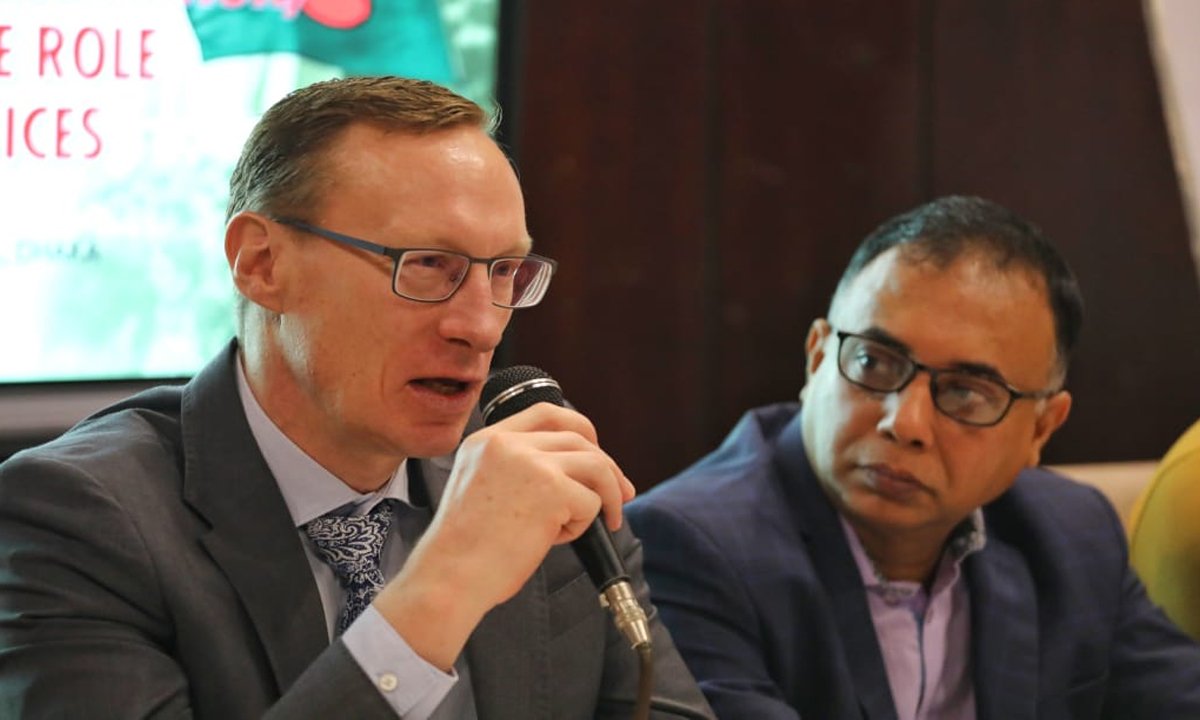
The workshop aimed to encourage ideological exchange among young political activists and strengthen democratic coexistence and pluralism in Bangladesh.
The session began with opening remarks from CGS President Zillur Rahman, CGS Executive Director Parvez Karim Abbasi, and FES Bangladesh Program Advisor Sadhan Kumar Das.
Speaking at the event, Zillur Rahman emphasized that political stability is a prerequisite for economic stability. “When we talk about democracy or politics, public perception plays a vital role,” he said. “An election alone does not ensure democracy, but without elections, the democratic process cannot begin. Bangladesh is now heading toward a national election, and it remains to be seen how that process unfolds.”
He noted that while Bangladesh has around 55 registered political parties, only 18 have signed the ‘July Charter’. “Women make up nearly half of the population, yet their representation- along with that of other minorities- has been notably limited in this historic process. Therefore, how this consensus was reached remains a matter of reflection,” he added.
In his remarks, Parvez Karim Abbasi highlighted the uneven power dynamics in Bangladesh’s electoral history. “In previous elections, those who came to power often became immensely powerful afterward, while those who lost would virtually disappear from the scene,” he said. “When we discuss political minorities, the issue of religious minorities naturally arises. Economic marginalization also remains a major challenge, where the same privileged groups continue to benefit repeatedly. Meanwhile, cultural marginalization is increasingly evident, often enforced through coercion- and sometimes with state support.”
Speaking on behalf of FES, Felix Gardes said, “It is a pleasure to participate in this debate with young politicians. Our organization is rooted in social democratic values. Since the post-World War II period, we have been committed to promoting democracy through research, political discussions, and public debates.”
“As Bangladesh prepares for an election under special circumstances, I sincerely hope the people of the country will experience a just and fair process,” he continued. “The issue of minority rights remains a crucial element of democracy worldwide, as the tyranny of the majority is not necessarily better than the tyranny of the minority.”
The workshop was moderated by writer and researcher Maha Mirza.
Throughout the day-long program, representatives from various student political organizations took part in discussions on democracy, ideological differences, and current political realities. Despite divergent political views, participants engaged in constructive and respectful dialogue, reflecting a shared commitment to building an inclusive and democratic future for Bangladesh.


