

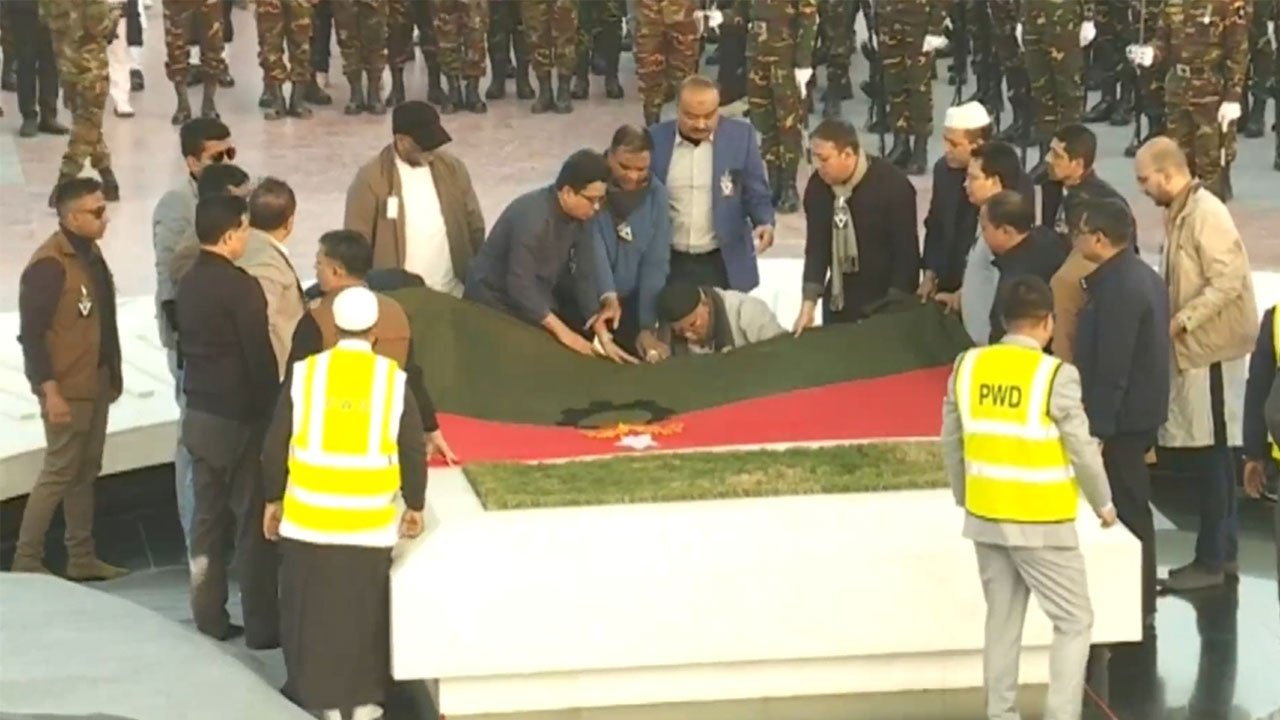
His funeral was held with state honors at around 4:30 pm on Wednesday (December 31). His eldest son Tarique Rahman participated in the funeral process.
At that time, Tarique Rahman's wife Dr. Zubaida Rahman, daughter Jaima Rahman and Arafat Rahman Koko's wife Sharmila Rahman Sinthi and other family members were present at some distance. Apart from this, BNP Secretary General Mirza Fakhrul Islam Alamgir, members of the party's standing committee and leaders of various political parties stood there to witness the burial process.
Earlier, Khaleda Zia's body was taken from the South Plaza of the Parliament Building to Zia Udyan. After being taken near the tomb of former president and husband Ziaur Rahman, members of the army and navy carried Khaleda Zia's coffin on their shoulders to the grave. After that, the burial process was completed according to the rules.
Earlier, Khaleda Zia's funeral was held at the South Plaza of the National Parliament Building and Manik Mia Avenue at around 3 pm. The funeral was attended by Chief Advisor Dr. Muhammad Yunus, Army Chief Waqar Uz-Zaman, top leaders of BNP and various parties, and lakhs of ordinary people.
Before the funeral, Tarique Rahman asked for prayers for his mother and apologized to everyone on her behalf.
Khaleda Zia, the 'uncompromising leader', rests in eternal sleep next to her husband
Khaleda Zia, who had been suffering from a serious illness for a long time, breathed her last at 6 am on Tuesday at the capital's Evercare Hospital. She was 80 years old at the time of her death.
Former Prime Minister Khaleda Zia, 79, had been suffering from various complications including arthritis, diabetes, kidney, liver, lung, heart and eye problems for a long time. She returned home after recovering somewhat after receiving treatment in London on January 7 this year. But she fell ill again and was admitted to the hospital on November 23. She died yesterday after being treated in the hospital for about a month and a half.
Khaleda Zia, who came from a housewife's life to politics, led the party for 43 years. She joined the BNP in 1982 and was elected unopposed as the BNP chairperson in 1984 through the council. From then on, Khaleda Zia served as the party chairperson until her death. In addition to being the BNP chairperson, she was elected prime minister three times. After the anti-Ershad movement, Khaleda Zia was given the title of 'Uncompromising Leader'. She made history by becoming the first female prime minister of Bangladesh.
Khaleda Zia's political career began with the pain of losing her husband Ziaur Rahman. After Ziaur Rahman was assassinated on May 30, 1981, the BNP was in crisis. It was at that time that Khaleda Zia, an ordinary housewife, took over the reins of the BNP.
In her four-decade long political career, Khaleda Zia has never been seen speaking in a manner that attacks her opponents. In an interview, the former prime minister said, "I never speak in a manner that makes personal attacks."


