

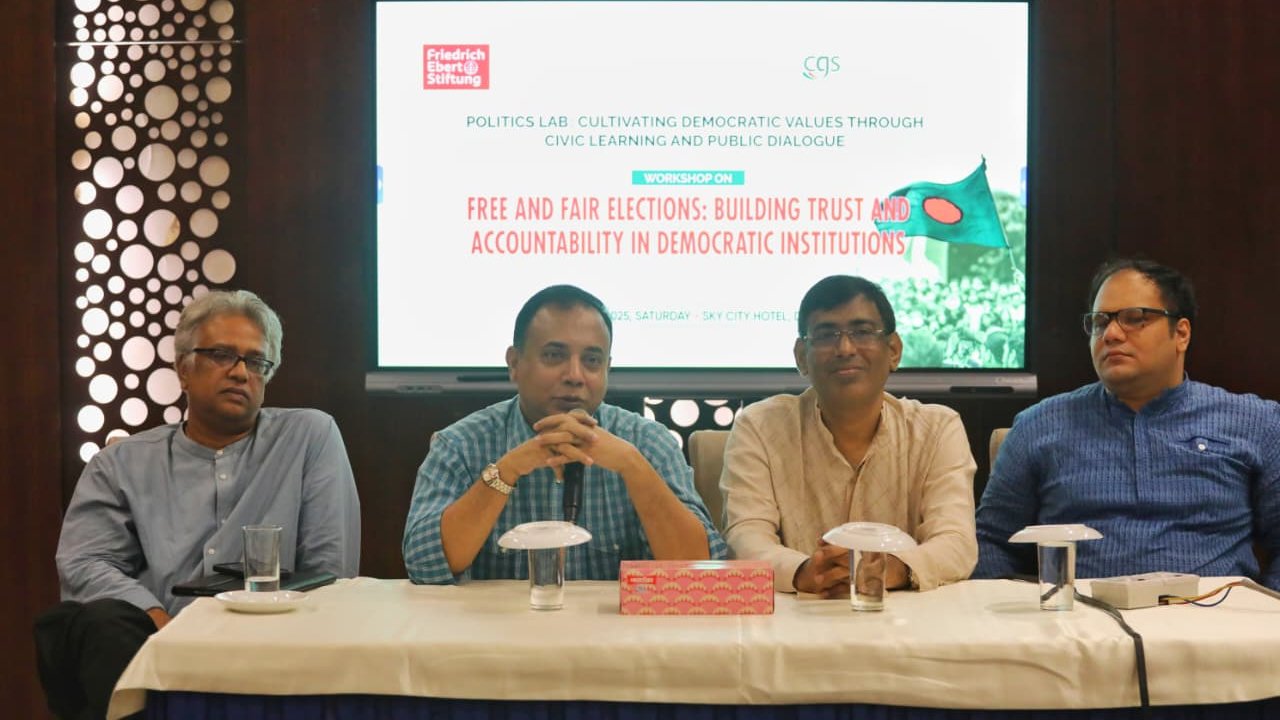
The workshop was organized by CGS in collaboration with Friedrich Ebert Stiftung (FES) as part of CGS’s ongoing initiative to encourage ideological dialogue and strengthen democratic practices among young politicians in Bangladesh.
The event aimed to foster pluralism, accountability, and democratic coexistence by bringing together young political activists from different student organizations across the country.
In his opening remarks, Zillur Rahman highlighted the historical significance of student politics in Bangladesh, noting that “DUCSU is a glorious chapter in our history. Students have always played an anti-establishment role, which the nation has always relied on. But the government has never spontaneously held DUCSU elections. The last DUCSU election was the weakest and most shameful. I believe the upcoming national election is also unlikely to be free and fair, and I do not consider the current government to be neutral. Where the rule of law is established, accountability and fair elections become possible, and elections are indispensable for entering the democratic process.”
Parvez Karim Abbasi, Executive Director of CGS, underscored the centrality of elections in Bangladesh’s political struggles. “To reflect the aspirations of the people, accountability must be ensured. In Bangladesh’s history, even before independence, all major upheavals revolved around elections. The central criticism of fascist rule has also been the question of elections. The main aim of today’s workshop is to broaden knowledge about the steps needed to organize a free, fair, and impartial election,” he said.
Echoing these concerns, Sadhan Kumar Das, Program Advisor of FES Bangladesh, said, “To consolidate all elements of the democratic process, a government formed through free, fair, and impartial elections is essential. In the run-up to the upcoming election, today’s workshop is particularly significant.”
The workshop sessions were conducted by Dr. Asif M. Shahan, Professor of Development Studies at the University of Dhaka.
Throughout the day-long program, student representatives from different political organizations engaged in discussions on democracy, ideological divides, and contemporary political realities. Despite differences in political orientation, the participants collectively emphasized the importance of accountability and fair elections for the future of democracy in Bangladesh.


