
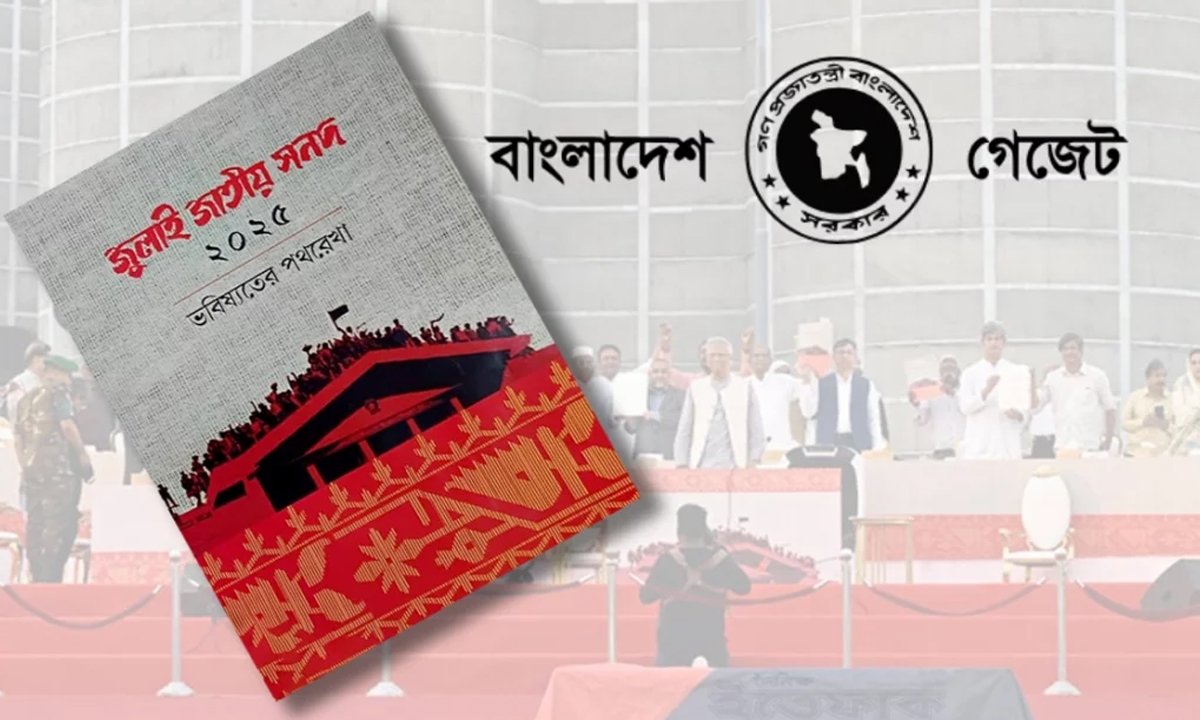
The gazette was published by the Legislative and Parliamentary Affairs Division of the Ministry of Law, Justice and Parliamentary Affairs after President Md. Shahabuddin issued this order on Thursday (November 13).
Earlier in July, the Advisory Council approved the National Charter (Constitutional Reform) Implementation Order, 2025. Chief Advisor Professor Muhammad Yunus signed the summary of the order before sending it to the President at noon.
The order said that in the continuation of the long democratic struggle, the sovereign power and will of the people were manifested through the successful mass uprising of the students and the masses in Bangladesh in July-August 2024, and as a result of that mass uprising, the then fascist government fell on August 5, 2024, the National Parliament was dissolved on August 6, and the current interim government was formed on August 8, which has gained effectiveness and recognition at the national and international levels.
In order to establish good governance, democracy and social justice through state reforms and prevent the recurrence of authoritarian and fascist rule, the interim government formed six reform commissions to formulate recommendations for reforms in the constitution, electoral system, public administration, judiciary, police administration and anti-corruption system, and those commissions submitted their respective reports to the government.
The government formed the National Consensus Commission on February 12 to establish a national consensus on the recommendations included in the reports.
The National Consensus Commission, in consultation with all political parties and alliances participating in the popular uprising, formulated the July National Charter 2025, which contained recommendations for constitutional reform and other reforms, and the political parties and alliances collectively pledged to sign the charter and implement it.
The implementation of the proposals included in the July National Charter on constitutional reform requires the approval of the sovereign people, and for this purpose, there is a need to hold a referendum, form a Constitutional Reform Council, and have that council reform the constitution.
Therefore, it is imperative to issue a formal order to complete the implementation of the July National Charter 2025. Therefore, the President issued this order based on the sovereign power and intention of the people expressed through the successful mass uprising of the students and the public that took place in July-August 2024, and in consultation with the interim government.
Short title and introduction
(1) This order may be cited as the July National Charter (Constitutional Amendment) Implementation Order, 2025.
(a) Articles 1, 2, 3, 4, 5, 6, 12 and 15 of this order shall come into force immediately and (b) Articles 7, 8, 9, 10, 11, 13 and 14 shall come into force on the date of publication in the Official Gazette, subject to the positive result of the referendum.
Definition
In this Order, unless the subject or context otherwise requires,
(a) “referendum” means a referendum held under this Order;
(b) "July Uprising" means the student-public uprising that took place in Bangladesh in July-August 2024;
(c) "July National Charter" means the July National Charter 2025 signed by political parties and alliances and the National Consensus Commission formed by the interim government;
(d) "National Parliament" means the National Parliament constituted under Article 65 of the Constitution;
(e) “Election Commission” means the Election Commission constituted under Article 118 of the Constitution;
(f) "Elected representatives" means all members of the National Parliament constituted in accordance with clause (2) of Article 65 of the Constitution;
(g) "Council" means the Constitution Reform Council constituted under Article 7 of this Order;
(h) "Chairman" means the person who presides over the meeting of the Council in accordance with Article 9 of this Order;
(i) "Constitution" means the Constitution of the People's Republic of Bangladesh; and
(j) "Parliamentary Election" means the general election of the National Parliament held immediately after the promulgation of this Order.
Referendum on constitutional reform included in the July National Charter . This order and the part of the July National Charter related to constitutional reform shall be submitted to a referendum for the purpose of exercising the sovereign power of the people.
Questions to be presented on the referendum ballot:
- The following question will be presented in the referendum: “Do you express your consent to the July National Charter (Constitutional Reform) Implementation Order, 2025 and the following proposals relating to the constitutional reform enshrined in the July National Charter?” (Yes/No):
(a) The caretaker government, the Election Commission and other constitutional institutions during the election period will be formed in light of the process outlined in the July Charter.
(b) The next National Parliament will be bicameral. An upper house of 100 members will be formed in proportion to the votes received by the parties in the National Parliament elections, and amendments to the constitution will require the approval of a majority of the members of the upper house.
(c) The winning parties in the next parliamentary elections will be obliged to implement the 30 proposals on various issues including increasing women's representation in parliament, electing deputy speakers and chairpersons of several parliamentary committees from the opposition, limiting the term of the Prime Minister, increasing the powers of the President, fundamental rights, independence of the judiciary, and local government, on which the political parties reached consensus in the July National Charter.
(d) Other reforms outlined in the July National Charter will be implemented as promised by political parties.
(2) The referendum shall be held by ballot and each voter shall vote secretly on the ballot determined by the Election Commission.
A referendum shall be held in accordance with this order on the day of the National Assembly election to be held immediately after the issuance of this order.
Legislation for holding referendums
Appropriate legislation will be enacted to enable the Election Commission to take necessary measures to hold the referendum.
Formation, functions and dissolution of the Constitutional Reform Council
(1) If the majority of votes cast in response to the question presented in the referendum is (yes) indicative,-
(a) A Constitutional Reform Council shall be formed consisting of the representatives elected in the general elections to the National Assembly to be held immediately after the promulgation of this Order, which shall exercise all powers in matters of constitutional reform;
(b) The representatives elected at that election shall simultaneously serve as members of the National Assembly and as members of the Constitutional Reform Council in accordance with this Order;
(c) The Council shall complete the constitutional reform in accordance with the July National Charter and the results of the referendum within 180 working days from the date of the commencement of its first session, and upon completion thereof, the Council's activities shall end.
(2) The elected representatives shall be referred to as members of the Council while participating in the proceedings of the Council.
(3) For the purpose of this Order, the Council shall determine the procedure for convening and adjourning its sessions, the procedure for raising proposals for constitutional amendments, the consideration and adoption of such proposals and all other matters.
(4) The National Parliament Secretariat shall provide secretarial support to the Council.
Administering oaths and oath-taking
(1) After taking the oath as members of Parliament, the elected representatives shall take the oath as members of the Council in accordance with Schedule-1 to this Order at the same oath-taking ceremony and sign the corresponding oath-taking certificate.
(2) In the case of members of Parliament elected in the parliamentary elections, the person who administers the oath shall administer the oath to the members of the Council in the form set out in Schedule-1 to this Order.
Chairman of the Council
(1) At the first meeting of the first session of the Council, the members of the Council shall elect its Chairman and Vice-Chairman; and until such election, one of the senior members of the Council shall, with the consent of the majority of the members, act as Chairman of the meeting.
(2) In the absence of both the Chairperson and the Deputy Chairperson, any Council member shall perform the duties of the Chairperson in accordance with the procedures of the Council.
Calling of council meetings, quorum, voting, etc.
(1) The first session of the Council shall be convened in the same manner as the first session of the National Parliament is convened within 30 calendar days of the declaration of the results of the parliamentary elections.
(2) The presence of a minimum of 60 council members shall be required for the conduct of the council's activities.
(3) A decision to approve any proposal relating to constitutional amendments shall be taken by a majority vote of the total number of members of the Council; and on other matters, decisions shall be taken by a majority vote of the members present and voting; provided that in the event of an equality of votes, the Chairman shall have the casting vote.
Special rights and immunities of the council and members
The validity of any proceedings of the Council and the special rights and immunities of the members of the Council shall be the same as those of the National Assembly and its members.
July National Charter Incorporation into the Constitution
In accordance with the commitment to implement the July National Charter, measures will be taken to include the July National Charter in the constitution.
Implement constitutional reforms immediately
(1) After the completion of the constitutional reforms in accordance with sub-section (1) (c) of section 7 of this order, the reforms which can be implemented immediately shall be implemented immediately and in this regard, the Government shall take all appropriate measures.
(2) Without prejudice to the generality of sub-paragraph (1) of this Article, an Upper House of the National Parliament shall be formed and its terms of reference shall be determined within 30 working days after the completion of the constitutional amendment in accordance with sub-paragraph (1) (c) of Article 7 of this Order, based on the proportional representation (PR) system of the votes obtained in the elections to the Lower House of the National Parliament.
(3) The term of the Upper House constituted under sub-section (2) of this Article shall be from the date of its taking the oath until the last day of the term of the Lower House of the National Assembly.
(4) It shall not be necessary to publish the list of candidates for the Upper House of the National Assembly during the parliamentary elections to be held immediately after the issuance of this order.
(5) The Council may make necessary provisions and the Government may issue necessary instructions for the purpose of removing any impediment to the formation of the Upper House in accordance with sub-section (2) of this article.
Finalization and publication of constitutional amendments by the council
(1) The constitutional amendment adopted by the Council shall be final and no other approval or consent shall be required with respect to such amendment.
(2) The Government shall forthwith publish in the Official Gazette the full text of the constitutional amendments adopted by the Council and the full text of the Constitution as so amended.
Instructions issued by the government
The government may issue necessary instructions to implement the provisions of this order.