
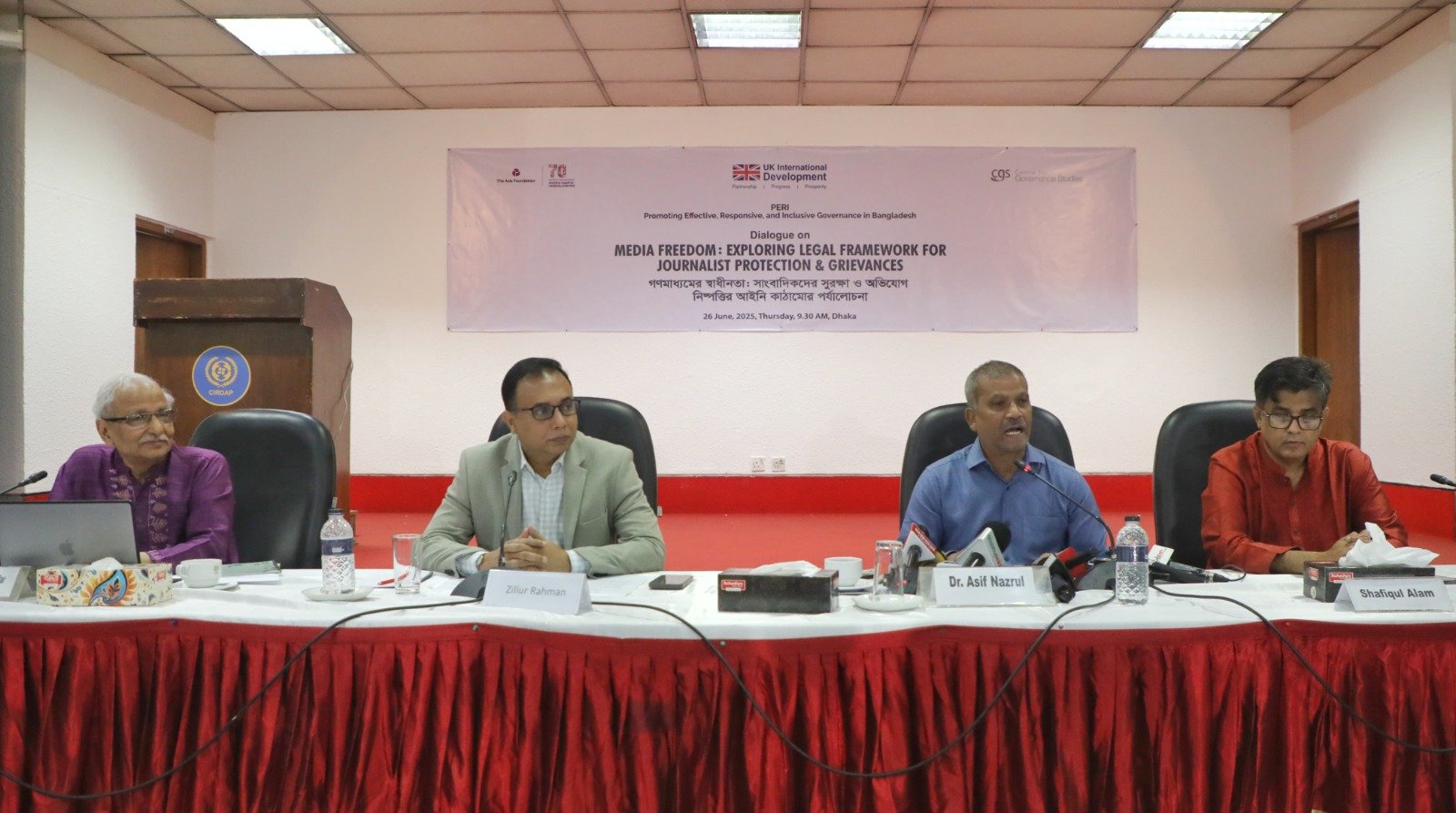
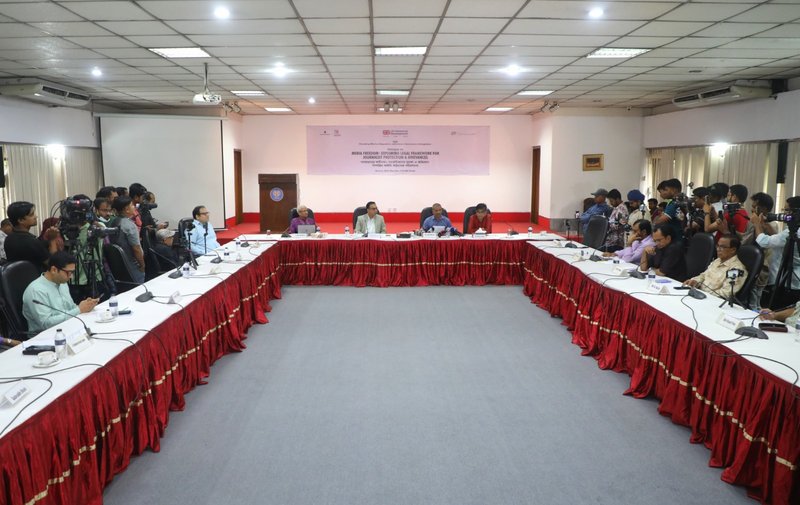
The Centre for Governance Studies (CGS) hosted an informative dialogue session on Thursday, June 26, 2025, at the CIRDAP Auditorium (Centre on Integrated Rural Development for Asia and the Pacific) to discuss reforms related to the mass media.
Asif Nazrul, Adviser for Law, Justice and Parliamentary Affairs of Bangladesh, Interim Government of Bangladesh; Dr. Badiul Alam Majumdar, Chief, Electoral Reform Commission; Shafiqul Alam, Press Secretary to the Chief Adviser of the Interim Government of Bangladesh; Dr Shahidul Alam, Founder, Drik Picture Library and Photojournalist; Mojibur Rahman Monju, Chairman of AB Party; Ruhin Hossain Prince, General Secretary, Communist Party of Bangladesh (CPB); Parveen F Chowdhury, Bangladesh Correspondent, NHK TV; Sohrab Hassan, Joint Editor, Prothm Alo; M A Aziz, Bangladesh Correspondent, Irrawaddy; Zahed Ur Rahman, Political Analyst; Dr. Shakhawat Hossain Sayantha, General Secretary, G-9, Bobby Hajjaj, Chairman, Nationalist Democratic Movement; Parvez Karim Abbasi, Assistant Professor, East West University, Senior Research Fellow, Centre for Governance Studies; Senior Journalist; Md Muktadir Rashid; Zyma Islam, Senior Reporter, The Daily Star; Qadaruddin Shishir, Founder and Editor of The Dissent. Moderating the session, Zillur Rahman the media and related institutions haven’t really discussed the issue of media reform or the commission’s report. There hasn’t been much discussion on television, nor have there been writings in newspapers. There’s been no dialogue on what kind of reforms are needed, how constructive the commission’s report is, or what its weaknesses are. It’s primarily with those considerations in mind that today’s roundtable discussion has been organized.
Asif Nazrul has said all cases under the Digital Security Act have been withdrawn. While there may not have been much in the media, there has been a lot of misinformation spread on social media. None of us have filed cases over this misinformation, nor have we protested we’ve left it to the people of the country. If a certain group sees an opportunity for business in filing cases, then there’s nothing we can do about it. There were 266 cases filed against journalists, but only 15 were arrested. Those who were named were charged for insider crimes or related amendments. We have no role in the cases they were filed by ordinary citizens. However, we’ve instructed that no one should be arrested without substantial evidence
Dr. Badiul Alam Majumdar said, most television channels, in order to secure licenses, included favorable statements in their applications to please the government. Their letters of commitment contained promises that aligned with the political ideology and strategies of the Awami League. In the application forms themselves, they expressed willingness to assist in implementing the political party’s vision. Based on these applications, licenses have been granted over the past fifteen years.
Shafiqul Alam said we are going through an extraordinary time. He has claimed that the Interim Government has not created any administrative barriers for journalism. He has pointed out three main ways in which the last regime controlled journalism, through administration, repressive laws and social favors. He said that the current government is not doing any of that practices. Over the past fifteen and a half years under Hasina, a trust deficit has developed we are trying to overcome that. We are working to ensure that the actions of that era are not repeated during our time, and we’ve been largely successful in that regard. We’re not using any administrative pressure to silence journalists or push them away from their profession. If a news report is false, we simply say it’s false and request its removal. Some comply, some don’t. We’re just letting people know it’s untrue everyone can take their own legal steps. There are demands for a Journalist Protection Ordinance, but what about those who are harmed by unethical journalism? Shouldn’t we also think about protecting them?
Dr Shahidul Alam said that practices of the journalism has lost credibility because they are not up to standards worldwide. He has expressed concerns that certain law enforcement agencies are exempt from giving information to the media which creates a barrier for journalists to create news. He has brought up a case against him on the ICT act in 2018. Among the various laws like the DSA, CSA, and CPO, we’ve observed that there’s one area where no change has been made—political sentiments have been given a distinct and special status. Everyone has feelings, yet in the case of religious sentiment, a specific priority has been given. Religious sentiment is the only emotion that will be protected, while others won’t be. This difference is something we need to reflect on
Mojibur Rahman Monju said, media gets stuck in the marketing department. That’s where the money is generated, where the revenue comes from. But in doing so, creativity gets stifled.
Ruhin Hossain Prince the journalism of Bangladesh has become a self-censored more than ever, the media houses are in a state of panic. The job of a journalist is to speak truth to power, but it has become a puppet of power. Unless we can push back against the tide of criminalized politics, no matter how well we speak or what good intentions we have, we won’t be able to make real progress. Within this prevailing dysfunctional structure, only through collective awareness and sincere efforts can we hope to make some headway.
Shakhawat Hossain Sayantha has said that the journalists are divided between themselves, they don’t have unity amongst themselves. They are not free because they have a tendency to be submissive to power. In this country, the safety of journalists cannot be ensured by legal frameworks alone. There is resentment among journalists toward the government, frustration toward media owners, and public distrust of journalists—this multi-layered anger and lack of confidence will not be easy to overcome. The responsibility to rebuild trust must first be taken up by the media itself.
Sohrab Hassan has said, today, the journalist community is divided. The government alone cannot be blamed for this division. It is up to us to overcome it and establish an institution dedicated to the protection of journalists. Protecting journalists doesn’t mean protecting media owners it’s also about safeguarding the professionals themselves.
Parvez Karim Abbasi has pointed out that there are many laws in place that are from an ancient time but are still in practice. Unless there is a shift in the mindset of the media, politicians, and academics, we won’t be able to bring about change in any area.
Zahed Ur Rahman said, What worries me is that our culture has deteriorated. Like many others, I don’t have high hopes that journalism or the media will suddenly be fixed.
Parveen F Chowdhury has said just having money shouldn’t be a gateway to open a media house. Someone with experience and expertise should be able to get a license to start a media. She has expressed dissatisfaction with the media in reporting the news, the journalistic standards are not there.
Qadaruddin Shishir has said that the people of Bangladesh are not trusting the journalists. The practices of the journalists are not people friendly, but they become submissive to whoever is in power. He has said no journalist or media house has tried to cleanse itself after 5th August, the government and the reform commissions have given their recommendations, but the journalists and media houses have not tried to reinvent themselves.
Zyma Islam said that the media houses just changed from one political ideology to another. They say that after August 5, murder or attempted murder cases have been filed against Awami League journalists. I did some work in collaboration with local representatives and compiled a list of about 267 individuals who faced such cases during July and August. After verifying their names, identities, and designations, it was found that only around 20% had political affiliations or were involved with Awami politics. The rest were ordinary people like you and me. The prevailing perception is that politically motivated cases are being filed only against those aligned with the Awami League—but that’s not accurate. In some instances, these cases may have stemmed from personal disputes.
Md Muktadir Rashid asked the law minister why journalists are being held in custody for having a political opinion. He has said this is a slippery slope that would create a dangerous precedent for the future. He has expressed concerns for the grassroot journalists and the fear of the mob as a threat for the future of journalism in Bangladesh. Among the five members of the committee, only Asif Nazrul has a background in journalism and none of the others, to my knowledge, have ever practiced journalism. This committee seems to have been formed solely to prolong a bureaucratic process. If you truly care about the freedom of the media, then you need to look to the people who, over the past fifteen to seventeen years, have raised their voices and stood on the streets for press freedom.
M A Aziz said democracy is the pillar that would withhold journalism and news agencies. The press council should have power and influence. The press club has been invaded by these so-called coordinators, journalists are also
Bobby Hajjaj has said that the uprising of the people has not changed the practices of the journalists. The editorial and management board needs to be separated, otherwise there won’t be non partisan journalism. He has suggested a Press Freedom Caucus for the upcoming parliament.