
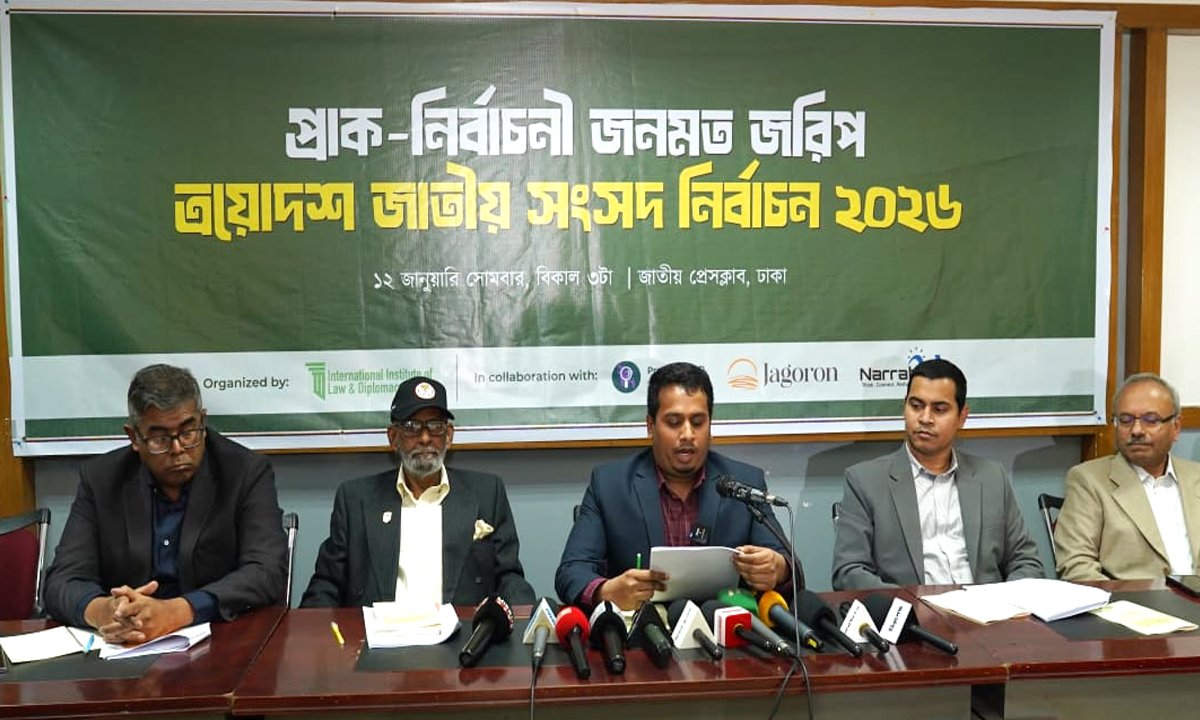
According to the survey, BNP is projected to lead with 34.7 percent of the vote, while Jamaat-e-Islami is expected to secure 33.6 percent. The findings were presented at the National Press Club in Dhaka on Monday (January 12).
The survey, titled “Pre-Election Pulse: An In-Depth Analysis of the Bangladeshi Electorate,” was jointly conducted by Projection BD, the International Institute of Law and Diplomacy (IILD), Jagran Foundation, and Narrative ahead of the national parliamentary elections.
The survey was conducted between November 21 and December 20, 2025, and included responses from 22,174 registered voters across 295 parliamentary constituencies in all 64 districts of the country. Researchers followed a stratified sampling design to ensure geographic, urban-rural, and demographic representation, with post-stratification weighting applied based on the 2022 National Census.
Based on current public support, the survey estimates that BNP will receive 34.7 percent of the vote, while Jamaat-e-Islami will receive 33.6 percent. An estimated 17.0 percent of voters remain undecided.
Among other political parties, the National Citizens Party (NCP) is projected to receive 7.1 percent of the vote, Islami Andolan Bangladesh 3.1 percent, and other parties collectively 4.5 percent.
However, machine learning-based projections suggest that if the voting tendencies of undecided voters are taken into account, BNP’s support could rise to 43.2 percent, while Jamaat-e-Islami’s support could increase to 40.8 percent.
Among BNP supporters, 72.1 percent cited the party’s past governing experience and administrative capability as the main reasons for their support. Demographic analysis shows that BNP enjoys stronger backing among working-age voters, particularly those aged 30–44 (38.4 percent) and 45–59 (37.4 percent). Professionally, the party has significant support among farmers (42.6 percent) and industrial workers (40.6 percent).
In contrast, Jamaat-e-Islami’s support is largely driven by perceptions of integrity and reform. According to the survey, 44.8 percent of Jamaat supporters cited “less corruption” as their primary reason for support, while 40.7 percent pointed to the party’s “image of honesty.” Jamaat’s strongest support base is among young voters aged 18–29, where it received 33.6 percent support.
The party also performs strongly among highly educated voters, securing 37.4 percent support among those holding a master’s degree—the highest among all parties. The survey notes that Jamaat-e-Islami leads in engaging young and educated voters through digital and social media platforms.
The survey found that 36.7 percent of respondents who support the National Citizens Party (NCP) cited the party’s role in the July Revolution as the primary reason for backing it, highlighting the influence of recent political movements on voter behavior.
According to the survey, 17 percent of voters remain undecided. Among them, between 30.1 and 34.7 percent said they do not trust any political party, while between 34.7 and 38.6 percent declined to express a clear opinion. Analysts suggest that this group could ultimately act as a “game changer” in determining the final election outcome.
The survey concludes that the 2026 parliamentary election is shaping up to be both a philosophical and political contest pitting BNP’s emphasis on experience and economic security against Jamaat-e-Islami’s focus on integrity and justice. A significant number of voters also expressed demands for institutional reforms, stronger anti-corruption measures, and justice related to the July coup.