

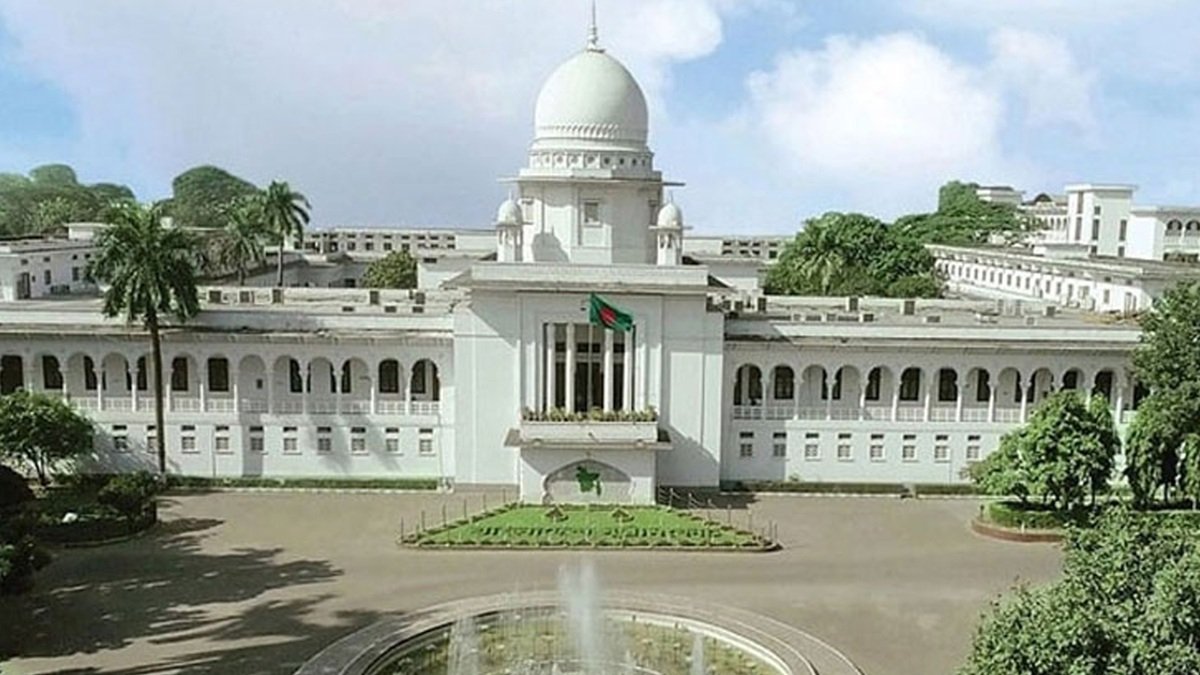
A High Court bench comprising Justice Shashank Shekhar Sarkar and Justice K.M. Zahid Sarwar Kajal delivered the verdict on Monday following a final hearing on the rule issued in this regard. Barrister Sheikh Mohammad Zakir Hossain presented arguments for the writ petition during the hearing.
Earlier, on September 16, the High Court issued a rule asking why the four constituencies in Bagerhat should not be restored and why the EC’s gazette notification reducing them to three should not be declared invalid. The court directed the Election Commission and other concerned parties to respond within 10 days. This rule was issued by the bench of Justice Md. Mujibur Rahman Mia and Justice Biswajit Debnath.
Senior lawyer Barrister Sheikh Muhammad Zakir Hossain appeared for the petitioners, assisted by Advocate Biplob Kumar Poddar, Advocate Faisal Mostafa, Advocate Razia Sultana, Barrister Kazi Samantha Enam, Advocate Aminuzzaman Sohag, Advocate Enamul Islam, Advocate Mahbubur Rahman, and Advocate Tanvir Ahmed. Assistant Attorney General Md. Ikramul Kabir represented the state.
Two writ petitions had earlier been filed in the High Court seeking reinstatement of Bagerhat’s four parliamentary seats. The petitions were jointly submitted by the Bagerhat Press Club, District Bar Association, District BNP, District Jamaat-e-Islami, District Islami Andolan Bangladesh, and the District Truck Owners Association. The respondents named in the petitions included the Bangladesh government, the Chief Election Commissioner, the Election Commission Secretary, and the Attorney General.
Ahead of the 13th National Parliamentary Election, the Election Commission proposed on July 30 to reduce Bagerhat’s constituencies from four to three. The proposal triggered widespread protests from local political parties and civic groups, who formed an all-party joint committee and organized demonstrations, strikes, and blockades demanding that all four constituencies be retained.
Despite the opposition, the EC published its final gazette on September 4, confirming the reduction to three constituencies. The new demarcation outlined Bagerhat-1 as Bagerhat Sadar, Chitalmari, and Mollahat; Bagerhat-2 as Fakirhat, Rampal, and Mongla; and Bagerhat-3 as Kachua, Morelganj, and Sharankhola.
Local leaders and organizations criticized the EC’s decision, alleging it ignored public opinion and undermined democratic representation.
Historically, since 1969, Bagerhat has had four parliamentary constituencies: Bagerhat-1: Chitalmari, Mollahat, Fakirhat. Bagerhat-2: Bagerhat Sadar, Kachua. Bagerhat-3: Rampal, Mongla. Bagerhat-4: Morelganj, Sharankhola. With the High Court’s ruling, the original four-constituency structure in Bagerhat is now to be reinstated.


